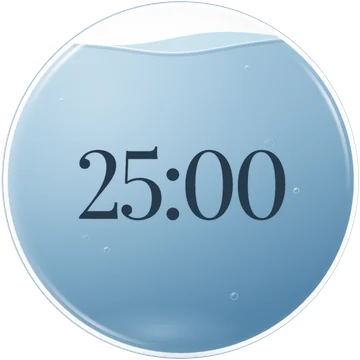
The app’s timer, available on iPhone.
ADHD time blindness: why time slips away from you
You check the time, and it doesn’t tell you what’s left. What the studies measured, and why seeing time drain away can help more than reading it.
Discuss this article with
Contents,4 sections
You checked the time, twice even, and it told you nothing. The second time, it was 1:31 p.m. at the bottom of your screen. You thought “I’ve still got time,” without working out how much, and went back to your sentence. You meant to leave at 1:40, to be early. When you looked up again, it was 1:52, and your meeting started at 2 p.m., a fifteen-minute walk away.
At 1:31, the clock didn’t say “nine minutes until you leave.” You had to work that out in the middle of a sentence, from a departure time you hadn’t written down anywhere. And at 1:40, nothing made you look up.
That gap between the time you read and the time you feel has a name, one you’ve probably come across already.
- Time blindness
Trouble feeling time go by and knowing how much of it is left, to the point of noticing the time too late.
The term says nothing about how long you can stay on a task. It’s about the clock moving on while you work.
Why you leave late, even with time to spare
You probably check the time as often as anyone. In an online game that recreated an apartment, adults with ADHD had things to do at set times1. They looked at the in-game watch as often as the other players did, about twenty times. Over five days, they also kept a diary of their everyday slips, and they wrote down nearly half as many again as the others.
A smaller experiment separates two kinds of forgetting. Adults with ADHD made breakfast on a computer, with its rules and its timings2. What they had to do when something happened, they did as well as the others. What they had to do at a given time, they did clearly worse.
Leaving at 1:40 is the second kind: nothing in your sentence reminded you of 1:40. You don’t forget your meeting, you forget that it’s now. Ten extra minutes of margin don’t change much: you still have to notice the moment they begin.
Try this
Get your departure time out of your head.
- An alarm at 1:40, when you need to get up, not at 2. When it goes off, there’s nothing left to work out.
- For the last “five-minute” thing, the sentence you wanted to finish, put a timer that visibly empties next to you, set for five minutes. If it runs out before your sentence is done, you see it in time to leave.
Is it ADHD, or an excuse?
People have blamed you for being late, and you’ve probably blamed yourself too. The term “time blindness” isn’t on the list of ADHD signs that American psychiatrists publish3. Yet that list mentions poorly managed time and missed deadlines, and in adults, forgetting: returning a call, paying a bill, showing up where you were expected.
You had planned to leave early. People who don’t care about the time don’t plan a margin. If you have to explain it to whoever was waiting for you, start there.
Being late, even often, isn’t enough to say you have ADHD. If you’re wondering about it, the French association TDAH France explains, in French, how adults are diagnosed.
In the lab, seconds rather than hours
That leaves the afternoons when you stop checking the time altogether. A task absorbs you, and you look up much later than you thought. That happens to everyone, with or without ADHD. What ADHD changes about the sense of time has been measured over much shorter spans.
Gathering what had been published on adults between 2012 and 2022, one researcher kept only nine studies4. In them, people estimate a length of time, or reproduce it, from half a second to a minute, and four minutes just once. Most find a gap with other adults, and the author doesn’t know whether they capture everyday life as a whole.
An older experiment shows which way that gap goes. Asked to reproduce fifteen seconds or a minute, young adults with ADHD stopped sooner than the others5. Their minute was shorter, the opposite of time slipping by.
Your lateness looks more like the computer breakfast: a set time that nothing reminds you of.
Does a visual timer really help?
A visual timer shows the time left as an area or a level that goes down. What it changes follows from the experiments above.
Next to the time in digits and your phone’s alarm, it doesn’t ask the same thing of you.
The time, a level, an alarm
| Your cue | What it asks of you | When it reaches you |
|---|---|---|
| The time in digits | Reading it, then doing the math | When you think to look at it |
| A level going down | A glance | As soon as it crosses your line of sight |
| An alarm | Setting it once | On its own, at the time you chose |
A level doesn’t tell you the exact minutes, and you don’t need them: it tells you whether there’s a lot left or a little. Set next to your keyboard, it catches your eye without you deciding to look at it. Try it for a week, and keep it if it helps.
In the app
The time left shows in the level of the water going down, and you can hide the numbers to keep only the water.
On iPhone, that level and the time left also appear on the Lock Screen and in the Dynamic Island, if you allow Live Activities. The help page says where to see them outside the app, depending on your iPhone and its iOS version.
The time at the bottom of your screen was the same for everyone waiting for you. It tells you how far along the day is. How long you had left before you had to go, it never told anyone.
Common questions
Is time blindness a diagnosis?
No. The phrase isn’t in the ADHD criteria, even though they mention poorly managed time and missed deadlines. It’s an image that comes from a psychologist’s theory of ADHD, which speaks of temporal myopia. For how a diagnosis is made in adults, the French association TDAH France explains it, in French.
Does time blindness mean ADHD?
Not on its own. Losing track of time when a task absorbs you happens to everyone, in the lab too. Time seems to pass more slowly during depression, and differences are described in autism. Among children with ADHD, this difficulty affected only some of them.
Sources
- Assessment of goal-directed behavior and prospective memory in adult ADHD with an online 3D videogame simulating everyday tasks, Scientific Reports, 2023.
- Task dissociation in prospective memory performance in individuals with ADHD, Journal of Attention Disorders, 2014.
- What is ADHD?, American Psychiatric Association, 2025.
- Time Perception in Adult ADHD: Findings from a Decade-A Review, International Journal of Environmental Research and Public Health, 2023.
- Time perception and reproduction in young adults with attention deficit hyperactivity disorder, Neuropsychology, 2001.
Spotted a mistake in this article? Write to contact@